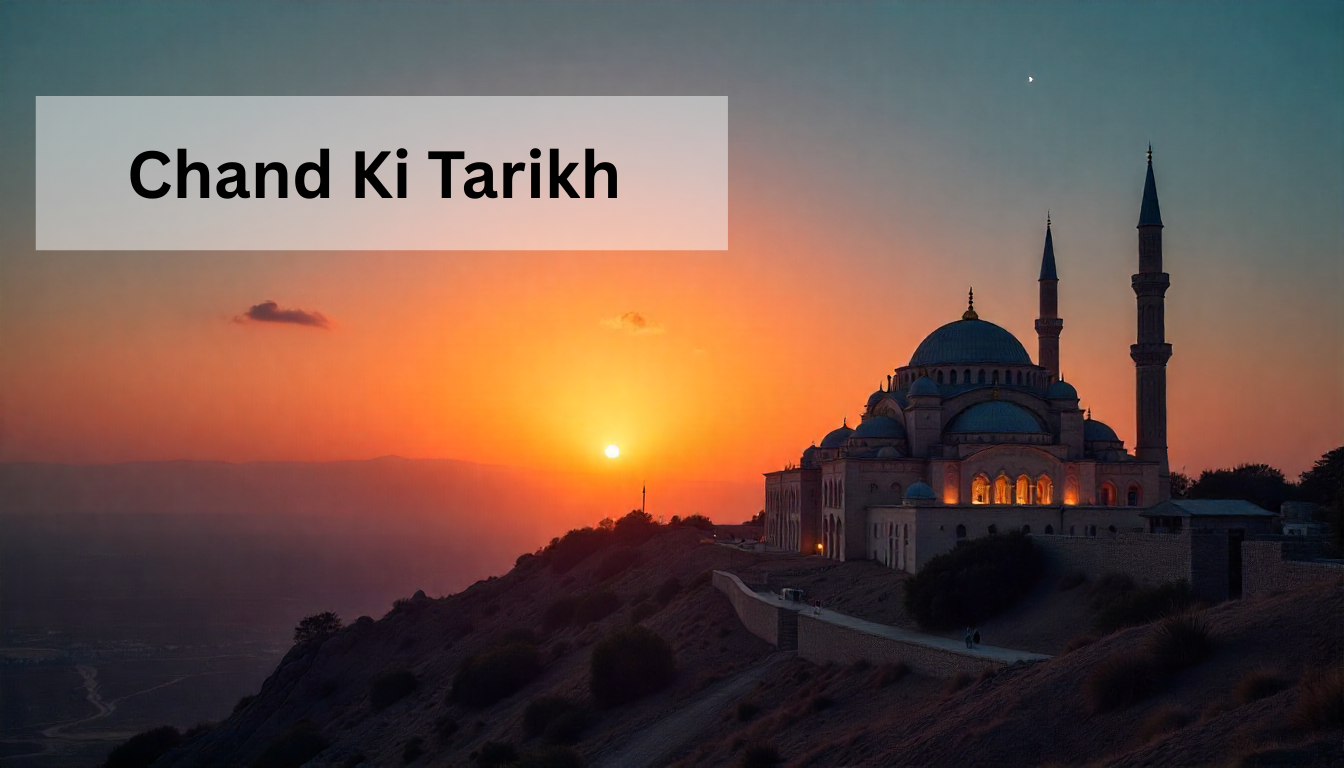
A different calendar is used in the Islamic world called Chand ki tarikh (moon date in Urdu). More formally known as the Hijri calendar, this lunar calendar system is the foundation for Islamic religious observances and daily life for 1.8 billion Muslims around the world.
What is Chand ki Tarikh?
Chand ki tarikh is the Islamic lunar calendar which has 12 months in a year of 354 or 355 days. Unlike the Gregorian calendar that follows the sun’s cycle, the Chand ki tarikh is entirely based on the phases of the moon. This system of date is also called by different names such as Hijri date, Arabic date, Muslim date or just as moon date.
The Chand ki tarikh today varies across different regions due to moon sighting differences. For example, as of August 31, 2025, Islamic chand ki tarikh today is 6 Rabi al-Awwal 1447 in India, Pakistan and Bangladesh and 8 Rabi al-Awwal 1447 in Arab countries such as Saudi Arabia, UAE and other countries around the world.
Historical Sources, Origin, and Meaning
The Islamic calendar was established from the time of Hijrah, the migration of Prophet Muhammad (peace, blessings and blessing of Allaah be upon him) from Mecca to Medina in 622 C.E. This event is the date of the start of Islamic era, thus the current Islamic date system is almost 1447 years old. The very word Hijri is derived from this important migration.
The Chand ki tarikh system is deeply significant in religion since it decides the dates of Islamic festivals, religious events and other important rituals. Important Islamic events such as Ramadan, Eid al-Fitr, Eid al-Adha and the Hajj pilgrimage all rely on proper moon sighting and the Chand ki tarikh.
The Twelve months of the Islamic calendar
The Islamic lunar year is made up of 12 months which begin each month with the sighting of the new moon:
- Muharram – The month of Allah, The first of the four sacrosanct months.
- Safar – The second month of the Islamic month
- Rabi al-Awwal – The third month is significant because of the birth of Prophet Muhammad (PEace and Blessings upon him)
- Rabi al-Thani – The fourth month.
- Jumada al-Awwal – The first of the two months of deficiency
- Jumada al-Thani – The sixth month (of the Islamic year).
- Rajab – The seventh month, another Holy month.
- Sha’ban – The eighth month, the month before Ramadan
- Ramadan – the ninth month, the month of fasting
- Shawwal – The tenth month, with Eid al-Fitr.
- Dhu al-Qadah – The month, the eleventh month, of sacred time.
- Dhu al-Hijjah – The twelfth month, with Eid al-Adha and Hajj.
How Chand ki Tarikh Today is Determined
The decision of Chand ki tarikh today is based on actual sighting of the moon rather than mere calculation from the point of view of astronomy. Islamic scholars and moon sighting committees in different countries look for the newly formed crescent moon to announce the start of every month. This traditional approach in dating sometimes results in different dates in different areas.
For example, the Islamic chand ki tarikh today might differ by one or two days between Saudi Arabia and South Asian countries like Pakistan, India, and Bangladesh. This difference is caused by the fact that the new moon might be visible in some areas but not visible in others because of atmospheric conditions, geographical location, and the moon’s position.
The variations in the current Islamic date for a specific region
The Islamic year may differ a lot in various Muslim-majority countries:
Middle Eastern Countries
In Saudi Arabia, UAE, and other Arab nations, the Chand ki tarikh today follows the moon sighting practices established by their respective religious authorities. These countries tend to declare the new month according to local committees of moon sighters.
South Asian Countries
Pakistan, India, and Bangladesh are known to follow their own following of moon sighting. The Islamic chand ki tarikh today in these countries might be one day behind or ahead of the Middle Eastern dates, depending on local moon visibility conditions.
Global Standardisation Activities
Some Islamic organisations call for a single global system of Chand ki tarikh to remove confusion and bring the Muslims together to celebrate religious events at the same time all around the world.
Why It’s Essential to Get Dates Right
Knowing the precise Chand ki tarikh is crucial for several reasons:
Religious Obligations
Muslims should know the specific Islamic date in order to fulfill religious obligations such as:
- Starting and ending the fast in Ramadan
- Celebrating Eid festivals in the right way
- Observing the rituals of Hajj at the specific times.
- Celebrating other religions
- Daily Spiritual Practice
The Chand ki tarikh today helps Muslims to remain in contact with the system of their lunar calendar and to keep themselves informed about the Islamic months and their importance. Each month has a spiritual meaning and suggested practices.
Community Coordination
Having accurate Islamic chand ki tarikh today information ensures that Muslim communities can coordinate religious events, prayers, and celebrations effectively.
Modern Technology and Chand ki Tarikh
In today’s digital age, determining the current Islamic date has become more accessible through various technological solutions:
Online Platforms
Numerous websites and applications provide real-time updates on Chand ki tarikh today, offering accurate Islamic dates for different regions worldwide. These platforms tend to offer such features as:
- Daily Islamic date updates
- Monthly calendar views
- Prayer time calculations
- Islamic Event notifications
- Mobile Applications
Today, Muslims all over the world can find it easier to check Chand ki tarikh as there are many apps developed for tracking the Islamic calendar on smartphones. These apps tend to be offline-based, and provide date accuracy based on location.
Government Resources
Many Muslim-majority countries maintain official websites and announce the Islamic chand ki tarikh today through their religious departments and moon sighting committees.
Challenges in Moon Sighting
The traditional way of establishing Chand ki tarikh has certain contemporary challenges:
Weather Conditions
In case of cloudy skies, storms and presence of atmospheric pollution, the visibility of the moon is hampered, and it will be hard to see the new crescent and thus deduce the exact current Islamic date.
Urban Light Pollution
Moon sighting is becoming harder and harder with more urbanization and light pollution in major cities, which may impact the accuracy of today’s Chand ki tarikh declarations.
Geographic Differences
The Earth’s curvature and different time zones mean that the new moon might be visible in some regions but not others, leading to variations in Islamic chand ki tarikh today across different countries.
Future of Islamic Date Tracking
The Islamic calendar system is in continual evolution but retains its basic lunar (lunar lunation) foundation:
Astronomical Calculations
Some Islamic scholars believe that precise astronomical calculations should be used along with traditional moon sighting to determine Chand ki tarikh. This fusion of traditions could reduce the regional differences while respecting the customs.
Global Coordination
Progress was made in the effort to establish a unified global current Islamic date system and various Islamic organizations are working to establish standardized criteria for moon sightings and communication networks.
Technology Integration
In the modern era, technological advancements such as advanced satellite imaging, astronomical software, and global communication networks are being utilized to ensure the accuracy and timeliness of Chand ki tarikh today predictions.
Practical Applications
The relevance of Chand ki tarikh goes beyond religious observance:
Business and Commerce
Many Muslim businesses determine their operations using Islamic dates, particularly during the time of Ramadan or Eid. Knowing the Islamic chand ki tarikh today helps in planning inventory, staffing, and marketing strategies.
Educational Institutions
Institutions of education in Muslim-majority countries frequently schedule holidays and academic activities on the basis of the Islamic calendar; precise current Islamic date information is therefore important in instructional planning.
Healthcare and Fasting
Health care professionals should be aware of the Islamic calendar to give proper attention during fasting months and should take into account religious dietary restrictions linked to periods of Chand ki tarikh.
Frequently Asked Questions
What exactly is Chand ki tarikh?
Chand ki tarikh means Islamic lunar calendar, or the Hijri calendar. Moon dating is a lunar calendar that is based on the lunar cycles with 12 lunar months and 354 or 355 lunar days in a lunar year. The word literally means “moon date” in Urdu and is used by Muslims throughout the world to determine religious observances, festivals, and important Islamic events.
How is Chand ki tarikh today determined?
The current Islamic date is determined through actual moon sighting by qualified observers after sunset. The new crescent moon (if it can be seen by the unaided eye) is the start of a new Islamic month. Modern day practices still include this traditional method by various committees or religious authorities for moon sighting in different countries, although in some regions, astronomical calculations are also added to facilitate the process.
Why does Islamic chand ki tarikh today vary between countries?
The difference in Islamic dates from one country to another lies in moon-sighting according to the geographical location, weather conditions, and visibility. The new crescent moon may be visible in one area but not another due to weather, pollution or moon position in the sky. Because of this, the current Islamic date in Saudi Arabia may be different from the current Islamic date in either Pakistan or India by one or two days.
What are the 12 months of Islam?
The Islamic calendar is made up of Muharram, Safar, Rabi al-Awwal, Rabi al-Thani, Jumada al-Awwal, Jumada al-Thani, Rajab, Sha’ban, Ramadan, Shawwal, Dhu al-Qadah and Dhu al-Hijjah. Each month starts with appearance of the new moon and can last 29 or 30 days. Four of these months – Muharram, Rajab, Dhu al-Qadah and Dhu al-Hijjah – are sanctified in Islam.
How religious practices are shaped by Islamic date system?
Knowing the correct current Islamic date is important for religious observance such as in fasting during Ramadan, Eid festivals, Hajj pilgrimage, and other important Islamic events. Muslims use the Islamic calendar to mark the beginning and end of religious observance, so precise datekeeping is important for worship and gathering.
Why is the Islamic year less than the Gregorian year?
The Islamic lunar year is shorter by 11 or 12 days than the Gregorian solar year because there are 354 or 355 days in an Islamic lunar year versus 365 or 366 in a Gregorian solar year. This variance of about 11 days causes the Islamic months to slowly drift through all seasons over a cycle of 32.5 years. For instance, Ramadan is celebrated in various seasons through the years, sometimes in summers while other times it’s in winters.
Can astronomical calculations replace traditional moon sighting for Chand ki tarikh?
While it has been argued by some Islamic scholars that astronomical calculations should be used to support traditional moon sighting, most Muslim communities continue to use visual confirmation of the new crescent moon. In many areas, a hybrid method is used, where astronomical predictions indicate possible times that the moon will be visible or not, and the final judgment is ultimately left to physical visibility by qualified observers.
How do Muslims of different timezones match Islamic dates?
Many Muslims in different time zones may follow the moon sighting of their local religious authorities or where they live (the country). Some communities may also act according to the decisions of major Islamic countries such as Saudi Arabia. This can result in Muslims in different parts of the world observing the same religious event on different days and this is usually accepted within Islamic jurisprudence.
What is the function of moon sighting committees in Islamic dates?
Moon sighting committees are groups of qualified Islamic scholars and astronomers designated by religious authorities to make the sighting of the new moon. These committees use telescopes, take into account atmospheric conditions and consult certain criteria to ascertain when a new Islamic month begins. Their announcements are then promulgated via mosques, media and official channels to inform the Muslim community.
How has modern technology impacted upon the Islamic calendar system?
Today, with advancements in technology and the accessibility of digital calendars and websites that display both Gregorian and Islamic date information, it’s become more straightforward to look up Islamic dates online. While technology helps forecast when the Moon will be full and when it will be visible, it hasn’t replaced the traditional way of moon sighting by hand. Rather, it is a supplemental resource to assist observers in finding out when and where to look for the new crescent moon.
Conclusion
Chand ki tarikh is not merely a system of date keeping, it is the spiritual pulsations of Islamic life and a unifying bond among the Muslims of the world and their religious origins. As we delve into the tapestry of modern life, the need for precise understanding of Chand ki tarikh today holds paramount significance for the followers of Islam.
Whether it’s checking the Islamic chand ki tarikh today to stay updated on religious duties or staying connected to the current Islamic date for cultural purposes, the lunar calendar system remains a crucial part of Islamic civilization. As the futile moon sighting continues to be balanced with the science, Chand ki tarikh will continue to be relevant and accessible to future generations of Muslims worldwide.
The Islamic lunar system is a beautiful system, based on the natural rhythms of the heavens, reminding people that there is order in the universe; it is a practical system for spiritual and temporal life. By celebrating and following Chand Ki Tarikh, Muslims can embrace the faith and brotherhood that transcend cultural and geographical borders.