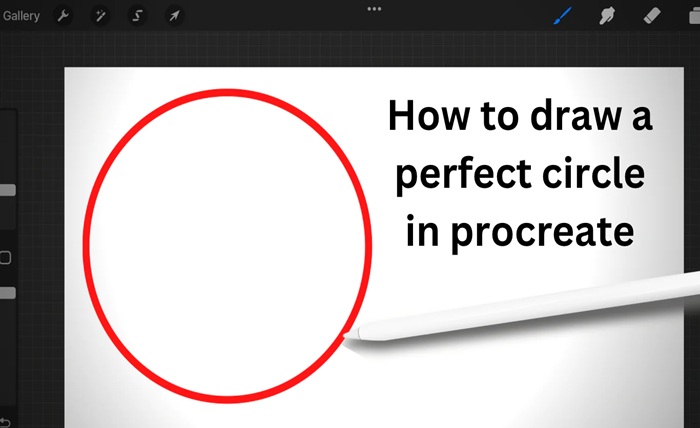
To draw a perfect circle means creating a shape that is equidistant from a single center point at all angles, resulting in flawless symmetry. When people attempt to draw a perfect circle, they often underestimate the mathematical and motor control precision required. A perfect circle has no bumps, flat edges, or distortions, and that’s why artists, designers, students, and even scientists are fascinated by the challenge to draw a perfect circle. Understanding this concept is the foundation before learning any practical method to draw a perfect circle accurately.
Why Learning to Draw a Perfect Circle Matters
Learning to draw a perfect circle is important across many fields such as art, engineering, geometry, logo design, and digital illustration. When you draw a perfect circle, you train hand-eye coordination and develop better spatial awareness. Many creative professionals consider the ability to draw a perfect circle as a benchmark of control and skill. From sketching faces to designing mechanical parts, the skill to draw a perfect circle improves overall precision and visual balance in any creative or technical task.
Traditional Tools That Help You Draw a Perfect Circle
Using traditional tools is one of the easiest ways to draw a perfect circle, especially for beginners. Compasses, round objects like coins, plates, or lids, and drafting tools are widely used to draw a perfect circle with consistent accuracy. When you draw a perfect circle using a compass, the fixed center and radius eliminate human error. Artists often rely on these tools when accuracy matters more than freehand expression, proving that tools remain essential to draw a perfect circle efficiently.
Freehand Techniques to Draw a Perfect Circle
Many artists aim to draw a perfect circle freehand as a personal skill challenge. One effective method involves rotating the paper while keeping your wrist steady to draw a perfect circle smoothly. Another technique is ghosting, where you repeatedly trace the motion in the air before touching the paper to draw a perfect circle. Although freehand methods rarely produce a mathematically perfect result, consistent practice can help you draw a perfect circle that appears visually flawless to the human eye.
Digital Methods to Draw a Perfect Circle
Modern technology makes it extremely easy to draw a perfect circle using digital tools. Graphic design software like Photoshop, Illustrator, Procreate, and even basic drawing apps include shape tools that instantly draw a perfect circle. By holding modifier keys such as Shift, users can constrain proportions and draw a perfect circle effortlessly. Digital artists prefer this method because it ensures precision, scalability, and symmetry when they need to draw a perfect circle for professional work.
Psychological and Motor Challenges When You Draw a Perfect Circle
Trying to draw a perfect circle reveals fascinating limitations of human motor control and perception. The brain struggles to coordinate smooth circular motion without visual distortion, which is why many people fail to draw a perfect circle freehand. Psychological pressure also plays a role; the harder you try to draw a perfect circle, the more tense your hand becomes. Understanding these challenges helps artists relax, allowing muscle memory and rhythm to improve the ability to draw a perfect circle naturally.
Daily Practice Exercises to Draw a Perfect Circle
Consistent practice is the key to learning how to draw a perfect circle. Artists often warm up by drawing multiple circles in rows, gradually improving smoothness and symmetry. Another effective exercise is drawing circles of different sizes while keeping proportions consistent to draw a perfect circle every time. Timed drills, blind contour circles, and repetition build muscle memory. With daily practice, anyone can dramatically improve their ability to draw a perfect circle confidently.
How Professionals Train to Draw a Perfect Circle
Professional artists, architects, and designers dedicate years to mastering precision, including the ability to draw a perfect circle. Many professionals combine tools, digital aids, and freehand practice to refine their skills. They understand that drawing a perfect circle is not about perfection alone, but control, consistency, and visual harmony. Professionals also analyze their mistakes to adjust technique, proving that learning to draw a perfect circle is an evolving skill rather than a fixed talent.
Conclusion
Mastering how to draw a perfect circle is both a technical and artistic journey. Whether you use traditional tools, digital software, or freehand techniques, the process teaches patience, control, and precision. While a mathematically perfect result may require tools, a visually perfect circle can be achieved through practice and understanding. By applying the methods and exercises discussed, anyone can improve their ability to draw a perfect circle and enhance their overall creative skill set.
FAQs
Q1: Can anyone learn to draw a perfect circle?
Yes, with practice and proper techniques, anyone can learn to draw a perfect circle.
Q2: What is the easiest way to draw a perfect circle?
Using a compass or digital shape tools is the easiest way to draw a perfect circle.
Q3: Why is it hard to draw a perfect circle freehand?
Human motor control and coordination limitations make it difficult to draw a perfect circle freehand.
Q4: Do artists actually need to draw a perfect circle?
Yes, many artistic and technical tasks require the ability to draw a perfect circle for balance and precision.
Q5: How long does it take to learn to draw a perfect circle?
With daily practice, noticeable improvement in the ability to draw a perfect circle can be seen within weeks.