
Bajri, commonly referred to as crushed stone or aggregate, serves as a fundamental building block for construction and infrastructure development across Pakistan. Keeping track of its fluctuating costs is essential for contractors, builders, and individual home developers looking to accurately manage their project budgets.
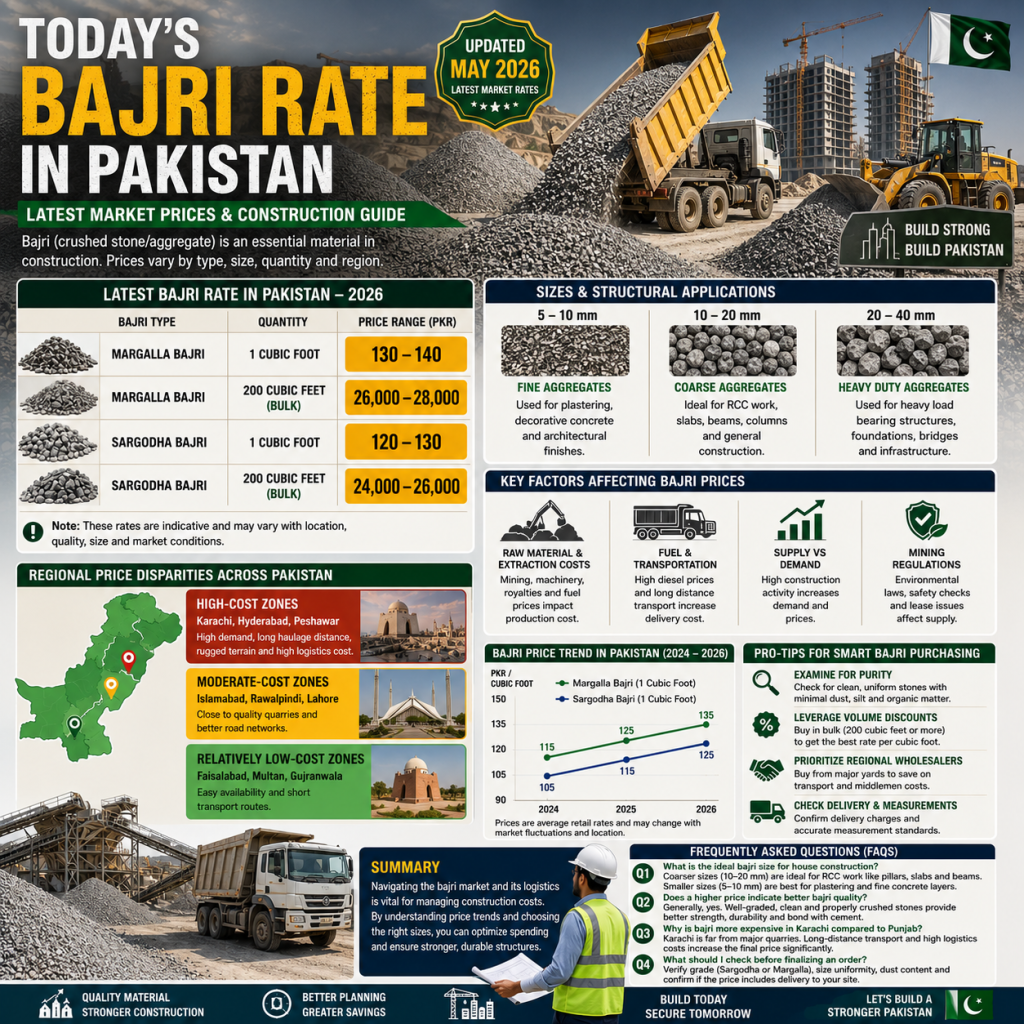
The current Bajri Rate in Pakistan reflects both material quality and transportation costs. As of the latest market updates, the average bajri rate in Pakistan generally ranges between 120 PKR and 140 PKR per cubic foot, depending heavily on the specific variety, aggregate size, and the sourcing region.
Latest Bajri Rate in Pakistan
The price of bajri varies based on its origin and the total volume purchased. Below is an overview of the current retail and bulk pricing structure for the most popular varieties used in local construction:
|
Bajri Type |
Quantity |
Price Range (PKR) |
|
Margalla Bajri |
1 Cubic Foot |
130 – 140 |
|
Margalla Bajri |
200 Cubic Feet (Bulk) |
26,000 – 28,000 |
|
Sargodha Bajri |
1 Cubic Foot |
120 – 130 |
|
Sargodha Bajri |
200 Cubic Feet (Bulk) |
24,000 – 26,000 |
Note: These baseline figures represent standard, widely used aggregate dimensions. Opting for premium grades, strictly standardized sorting, or specialized dimensions may incur secondary premium charges.
Understanding Sizes and Structural Applications
Selecting the correct aggregate size directly dictates the longevity and strength of your construction project:
- Coarse Aggregates (10–20 mm and 20–40 mm): These larger, heavier crushed stones are optimized for high load-bearing demands. They are structurally essential for pouring heavy concrete elements like beams, columns, bridges, and building foundations.
- Fine Aggregates (5–10 mm): These smaller crushed stones allow for tight compaction and a smooth texture. They are typically used for plastering blends, specialized decorative concrete work, and architectural finishes requiring high precision.
Key Factors Driving Bajri Prices in Pakistan
Just like cement, bricks, and sand, the market rate for aggregate experiences constant shifts due to several prominent economic variables:
- Raw Material and Extraction Costs: The expense of mining raw rock and gravel directly influences the final price. Changes in mineral availability, fuel price spikes, and machinery maintenance costs for quarry owners shift wholesale prices.
- Fuel and Transportation Logistics: Because crushed stone is exceptionally heavy, moving it from primary quarries to distant construction zones requires substantial fuel consumption. Higher shipping expenses routinely inflate retail rates in landlocked or distant districts.
- Supply vs. Market Demand: Real estate booms and active government infrastructure developments trigger massive demand for aggregates, resulting in market shortages and price increases. Conversely, low seasonal construction activity often cools prices down.
- Mining Regulations: Strict local environmental protections, lease renewals, and safety compliance checks can temporarily halt mining operations, restricting supply lines and raising operational overhead costs.
Regional Bajri Rate in Pakistan
The latest Bajri Rate in Pakistan varies according to aggregate type and region. Premium-quality aggregates often command a higher Bajri Rate in Pakistan. The cost of bajri is rarely uniform across the country due to localized logistics:
- High-Cost Zones (Karachi, Hyderabad, and Peshawar): Major coastal and southern metropolitan hubs like Karachi and Hyderabad experience elevated rates due to the sheer volume of high-rise construction combined with long haulage distances from northern quarry clusters. Meanwhile, Peshawar faces higher costs primarily due to rugged, difficult terrains that complicate distribution.
- Moderate-Cost Zones (Islamabad, Rawalpindi, and Lahore): Cities like Islamabad and Rawalpindi enjoy relatively stable, mid-range pricing due to their close proximity to premium quarry locations like the Margalla Hills. Similarly, smooth highway networks lower shipping costs for cities like Lahore, Faisalabad, Multan, and Gujranwala.
Pro-Tips for Smart Bajri Purchasing
Bajri is one of the most essential materials used in concrete construction across Pakistan. To stretch your construction budget effectively while preserving material standards, keep these guidelines in mind:
- Examine for Purity: Always inspect supply batches before unloading. High-quality aggregate should feature uniform shapes with minimal dirt, silt, or organic impurities.
- Leverage Volume Discounts: Sourcing your materials in bulk quantities (such as 200 cubic feet or larger dumpers) almost always secures a lower rate per cubic foot compared to buying piecemeal.
- Prioritize Regional Wholesalers: Mitigate heavy logistics fees by buying from major regional distribution yards rather than small, third-party sub-dealers.
Summary
Bajri Rate in Pakistan is generally lower when purchased in bulk quantities. Navigating the current bajri market and its logistical variables is vital for managing any construction project. By planning around regional price trends and choosing the appropriate aggregate sizes, project planners can easily optimize their spending and prevent costly project delays.
Frequently Asked Questions (FAQs)
Q1. What is the ideal bajri size for house construction?
It depends entirely on the application. For structural concrete like pillars, slabs, and beams, coarser aggregate sizes (10–20 mm) are necessary for load-bearing strength. For finer plaster finishes and detailed concrete layers, smaller sizes (5–10 mm) are best.
Q2. Does a higher price indicate better bajri quality?
Generally, yes. Well-graded, cleanly washed, and neatly crushed stones (like premium Margalla options) cost more than ungraded crusher runs because they offer vastly superior binding strength with cement.
Q3. Why is bajri more expensive in Karachi compared to Punjab?
The difference is almost entirely driven by transportation. Punjab cities sit much closer to major natural stone crushing hubs, whereas supplying Karachi requires long-distance heavy trucking, which adds steep fuel surcharges to the final bill.
Q4. What should I check before finalizing an order?
Ensure you verify the specific grade (Sargodha vs. Margalla), look for size uniformity, check for minimal dust content, and confirm whether the quoted price includes delivery directly to your construction site.